Rock Milling and Rock Grinding in Limestone Country: Turning Rough Hill Country Land into Usable Pasture
A practical guide to when rock milling or grinding makes sense for limestone Hill Country properties, how each process works, common uses like roads and pastures, and how Texas Ranch Construction approaches these projects.

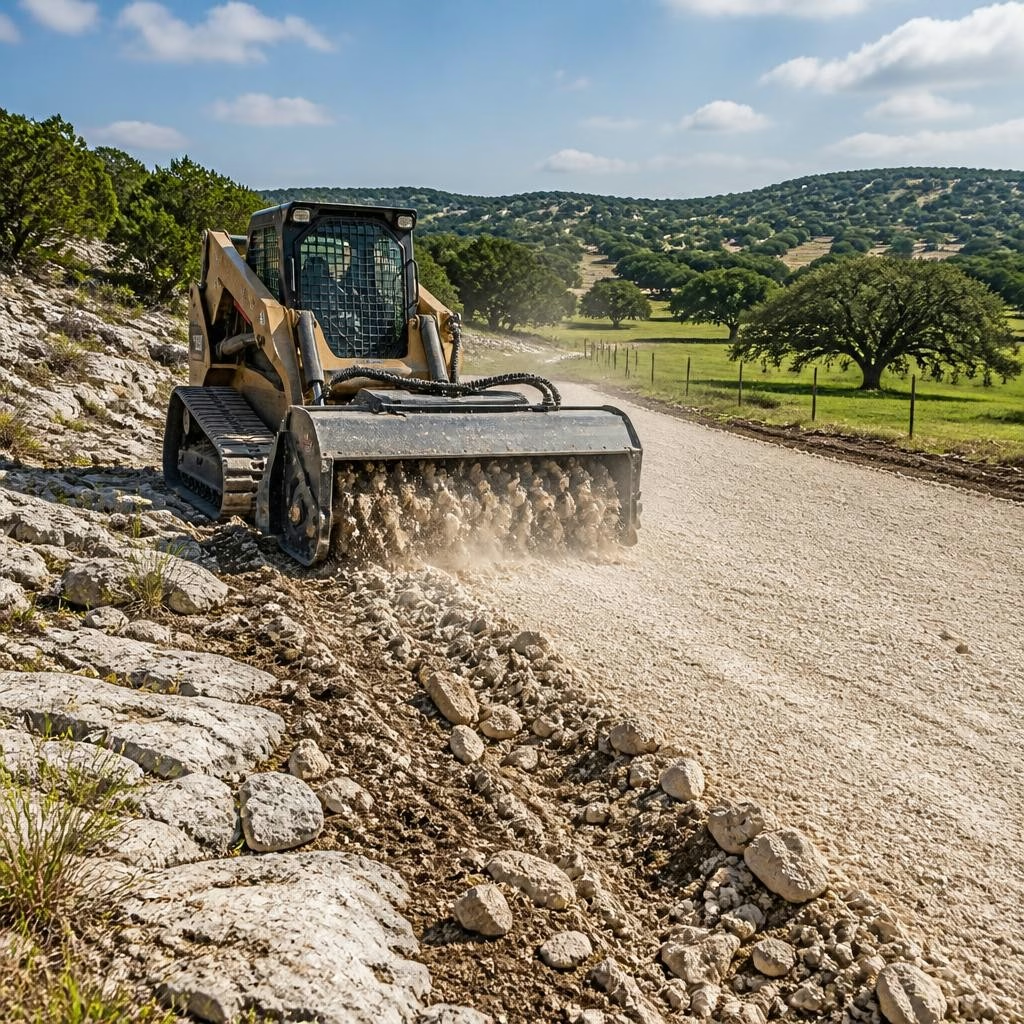
Why rock management is essential in the Texas Hill Country
Limestone outcroppings and thin soils are common across the Hill Country. On many ranches and small-acreage properties, hard surface rock near or at the soil surface limits water infiltration, reduces grazing area, creates rough terrain for equipment, and makes road and pad construction more expensive. Rather than hauling large volumes of rock off-site, owners often consider on-site solutions—rock milling and rock grinding—that convert bulky surface rock into usable material for roads, building pads, and to improve thin-soiled pastures.
What rock milling and rock grinding mean (and how they differ)
Rock milling typically uses specialized cutting teeth to break up near-surface limestone into smaller pieces while preserving the underlying soil profile. Rock grinding or rock pulverizing goes further, reducing rock into much finer aggregate or dust that can be spread and compacted. Milling tends to leave coarser, crushable material useful for road bases; grinding produces finer material that can be blended with soil to smooth terrain and improve compaction for pads or driveways. Both approaches avoid large-scale removal when conditions make hauling cost-prohibitive.
When milling or grinding makes more sense than hauling rock off-site
Choosing on-site milling or grinding is a practical, cost-sensitive decision driven by several factors: the depth and continuity of rock across the site, accessibility for trucks and heavy equipment, the intended end use (road base vs. pasture improvement), and disposal costs in your area. If rock is shallow and widespread, milling or grinding and reusing the processed material on-site usually costs less than trucking rock away and bringing in fill. Conversely, hauling may be preferable when large boulders are present, when local reuse is limited, or where environmental or permitting requirements demand off-site disposal.
Typical use cases: roads, building pads, and opening pasture
Processed limestone is commonly reused to build or improve ranch roads and driveways, create stable building pads, or fill shallow depressions. Coarser milled material works well as a compacted road base that resists rutting. Finer ground material can be spread and blended with native soil to reduce surface rockiness and create smoother, more usable grazing areas—especially where topsoil remains and revegetation is planned. Rock milling also makes fence-line work and access routes easier, helping long-term property management.
How the process typically works on a Hill Country property
A typical project begins with a site visit and assessment of rock depth, soil, drainage and access. Equipment such as high-torque milling heads or grinders is selected to suit the hardness and fracture pattern of Hill Country limestone. Operators mill or grind the rock to the required size, then redistribute and grade the processed material where it will be reused. Additional steps may include compaction for road bases, blending with topsoil, seeding or overseeding for pasture restoration, and, if needed, hauling oversize material off-site. Proper scheduling and water management during and after work help control dust and erosion.
Environmental and practical considerations to weigh
Maintaining proper drainage and minimizing erosion are critical after any milling or grinding operation. Preserving topsoil where possible and planning for revegetation will help reestablish forage and stabilize slopes. In some cases, permits or local regulations may apply—especially when work affects waterways, wetlands, or floodplains—so check county or municipal requirements before beginning. Equipment traffic can compact soil; strategic planning helps protect sensitive areas and avoids unnecessary disturbance to native vegetation.
How Texas Ranch Construction can help — next steps and contact
Texas Ranch Construction offers rock milling, rock grinding, and rock crushing services alongside land clearing, cedar mulching, and pond and lake construction across Kerrville and the Texas Hill Country. With over 20 years of experience working on ranch roads, building pads, and pasture improvement projects, the team evaluates site geology, access, and project goals to recommend milling, grinding, or hauling options that make economical and environmental sense. To discuss a specific property, get a site assessment, or request a quote, visit https://www.texasranchconstruction.com or call Texas Ranch Construction directly at (830) 431-8952. Service areas include Kerrville, Fredericksburg, Boerne, Llano, Comfort, Bandera, Johnson City and surrounding Hill Country communities.
Article by
Texas Ranch Construction
Texas Ranch Construction is your premier choice for expert land clearing services in Kerrville and the Texas Hill Country. Whether you need land clearing, cedar mulching, forestry mulching, brush removal, rock milling & rock crushing, or pond and lake construction, we’ve got you covered! With over 20 years of experience, we have established ourselves as a trusted leader in the industry. Our commitment to delivering top-quality results has made us the best choice for clients in Kerrville, Fredericksburg, Comfort, Sisterdale, Stonewall, Center Point, Harper, Llano, Boerne, Medina, Bandera, and Johnson City.