Planning an Earthen Dam for a Ranch Pond or Lake in the Texas Hill Country
A practical guide for ranchers and landowners outlining site selection, core-trench strategies in rocky soils, spillway planning, erosion control, and maintenance considerations when building earthen dams in the Texas Hill Country.

Why careful planning matters
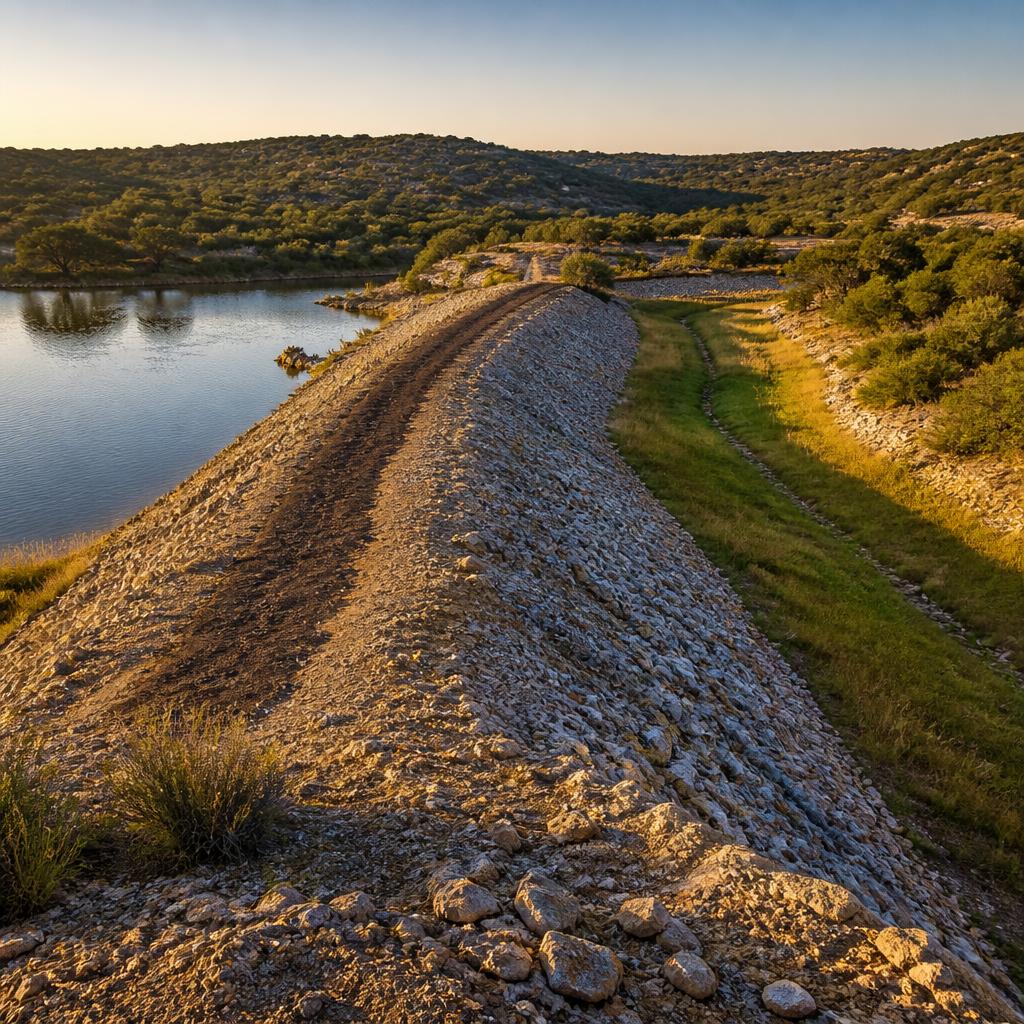
An earthen dam is more than a landscape feature—it's a long-term infrastructure investment that affects water management, grazing, wildlife habitat, and safety. On Hill Country properties the combination of limestone bedrock, variable soils, and episodic heavy rains makes early-stage planning essential. Texas Ranch Construction, with more than 20 years working across Kerrville and the Texas Hill Country, offers pond, lake, and earthen-dam construction services and can help translate planning decisions into practical construction steps.
Site selection: topography, watershed, and access
Start by evaluating the natural drainage pattern and the contributing watershed for the proposed impoundment. Ideal sites collect runoff without requiring excessive earthmoving; avoid areas that would direct concentrated overflow toward homes, roads, or neighboring properties. Consider road and equipment access, proximity to utilities, and any existing springs or seeps that might affect seepage and construction staging. Because local rules vary, confirm permitting and setback requirements with county authorities and local agencies before finalizing a site.
Understanding soils and the role of core trenching in rocky ground
A dam’s stability depends on foundation conditions. In the Hill Country, shallow limestone and cobble layers are common and can complicate cut-and-fill foundations. Core trenching creates a sealed interface between the dam embankment and underlying ground by removing unsuitable material and placing a compacted core. When rock is present at the proposed core depth, techniques such as rock milling, grinding, or targeted removal are often used to create a continuous foundation surface. Texas Ranch Construction provides rock milling and rock crushing services that help prepare rocky sites for earthwork, but a geotechnical evaluation is still necessary to determine the appropriate core approach and materials.
Spillway planning: sizing, routing, and protection
A properly planned spillway prevents overtopping—the leading cause of earth-dam failure. Choose a location that routes overflow away from structures and minimizes downstream erosion risk. Spillways should be designed so flows are dispersed and energy is dissipated before reaching vulnerable channels. Hard-point protection such as rock armoring along the spillway channel or reinforced aprons at discharge points reduces erosion. Because spillway dimensions and discharge paths are influenced by watershed size and local rainfall patterns, consult a qualified designer or engineer to establish an appropriate spillway layout for your site.
Erosion control and shoreline protection during and after construction
Control measures during construction—silt fences, sediment traps, temporary diversion channels—limit downstream sedimentation. For long-term shoreline protection, consider a combination of vegetative and structural approaches: native grasses and riparian plantings stabilize soils, while rock riprap or graded stone protects high-velocity zones such as spillway outlets. Texas Ranch Construction offers cedar mulching, forestry mulching, and rock grinding services that can be used to manage vegetation and produce material for erosion-control applications while keeping disturbed soil in place where appropriate.
Maintenance, monitoring, and vegetation management
After construction, regular inspections are essential—look for seepage, noticeable settlement, new gullies, or woody plants growing through the embankment. Periodic maintenance may include regrading berms, repairing spillway erosion, removing excessive sediment from the pool, and controlling invasive cedar or mesquite that can undermine embankment integrity. Services such as brush clearing, forest thinning, and fence-line clearing can help maintain accessibility and reduce woody regrowth around the dam and shoreline.
Next steps: coordinating construction with experienced contractors
Building an earthen dam on Hill Country terrain is a multidisciplinary effort: site evaluation, geotechnical testing, spillway design, earthmoving, rock handling, and erosion control all play a part. Texas Ranch Construction provides pond and lake construction, earthen dam work, rock milling/crushing, and vegetation-management services across Kerrville and the Texas Hill Country. For a site visit, scope review, or to discuss how these considerations apply to your property, contact Texas Ranch Construction directly at (830) 431-8952 or visit https://www.texasranchconstruction.com. They can work with your engineer and local permitting authorities to move a project from planning into safe, practical construction.
Article by
Texas Ranch Construction
Texas Ranch Construction is your premier choice for expert land clearing services in Kerrville and the Texas Hill Country. Whether you need land clearing, cedar mulching, forestry mulching, brush removal, rock milling & rock crushing, or pond and lake construction, we’ve got you covered! With over 20 years of experience, we have established ourselves as a trusted leader in the industry. Our commitment to delivering top-quality results has made us the best choice for clients in Kerrville, Fredericksburg, Comfort, Sisterdale, Stonewall, Center Point, Harper, Llano, Boerne, Medina, Bandera, and Johnson City.