Forestry Mulching vs Traditional Land Clearing in Central Texas: Costs, Timeframes, and Best Uses
A practical comparison of forestry mulching, dozer/land clearing, and hand-cutting for Hill Country properties, with guidance for small homesites, hunting parcels, and working ranches around Comfort, Medina, and Johnson City.

Introduction: Choosing the right clearing method in the Hill Country
Central Texas properties—from small homesites near Comfort to larger ranches around Johnson City and Medina—present a mix of rock, cedar, mesquite, and varied slopes. Choosing between forestry mulching, traditional mechanical clearing (commonly done with dozers and excavators), and hand-cutting depends less on trends and more on site conditions, intended land use, and priorities such as speed, soil protection, and cost. This article explains how each approach works and how landowners can decide which method fits their property and goals.
How the methods differ: mulching, mechanical clearing, and hand-cutting
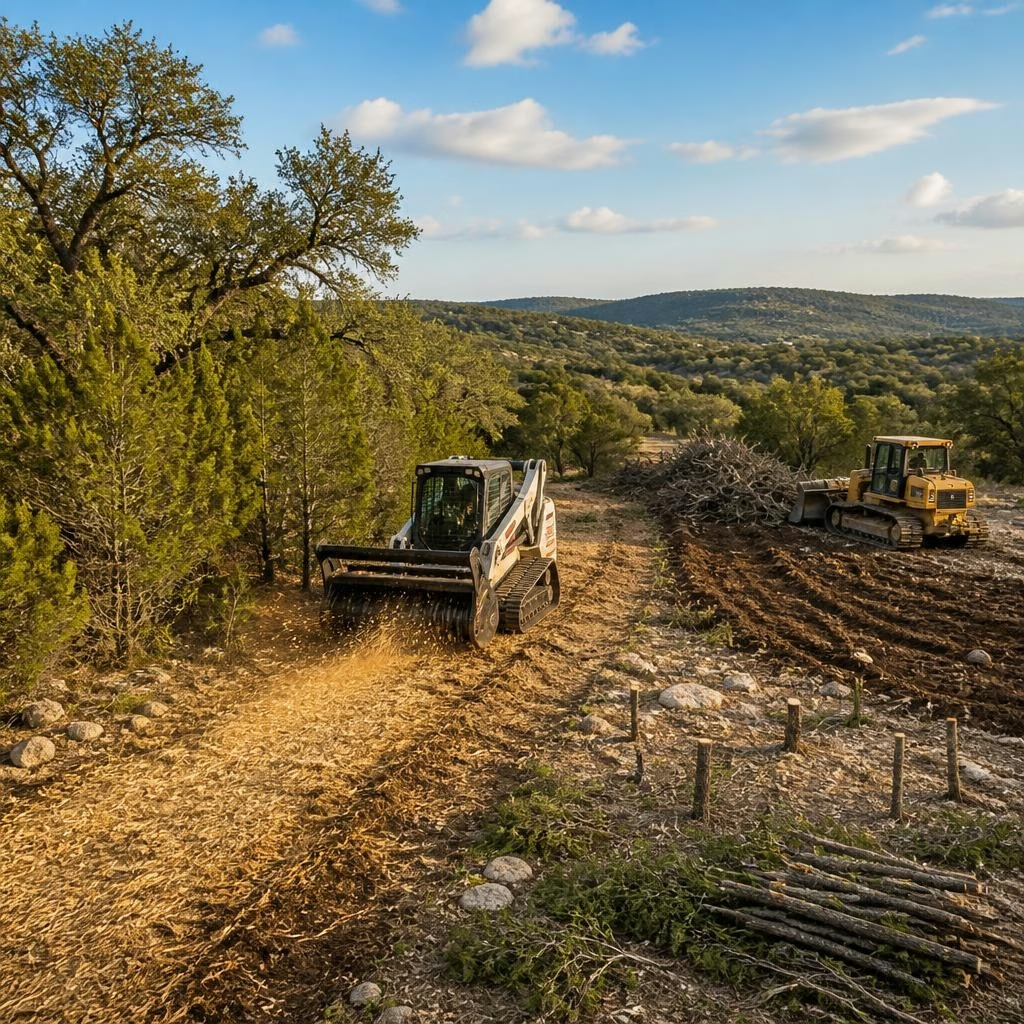
Forestry mulching uses a specialized mulching head to shred brush, cedar, and small trees in place and convert vegetation into a fine layer of organic material. Mechanical or dozer-style clearing typically uproots and pushes vegetation, stumps, and rocks offsite or into windrows. Hand-cutting relies on crews using chainsaws and manual removal for targeted clearing, pruning, or working around sensitive features. Each method produces different site conditions: mulching leaves a protective organic layer, mechanical clearing exposes more bare soil, and hand-cutting gives fine control at the expense of speed.
Cost and timeframe considerations
Budget and schedule are major drivers in choosing a clearing method. Forestry mulching is often faster than hand work and avoids multiple trips to haul debris, which can lower overall disturbance and cleanup time for many properties. Mechanical clearing can be fast for large, easily accessible tracts but may require additional hauling and grading, increasing time and cost for disposal and restoration. Hand-cutting is the most labor-intensive and typically the slowest option, used where precision is required. Because site variables (access, rock content, slope, and vegetation density) strongly affect pricing and schedule, landowners should obtain site visits and written estimates rather than rely on generic numbers.
Best uses by property type: homesites, hunting parcels, and working ranches
For small acreage homesites around Comfort and surrounding towns, forestry mulching often provides a tidy, low-impact finish that preserves topsoil and reduces the need for hauling. Hunting properties may prefer selective mulching or hand-cutting to produce scattered openings and preserve habitat structure while improving access. Working ranches frequently need broader clearing for fences, pens, pasture improvement, or road access; here mechanical clearing combined with follow-up mulching or rock grinding can be appropriate. In all cases, the intended post-clearing use—seeding, fencing, building, or wildlife management—should shape the choice of method.
Environmental, soil, and wildfire considerations
Forestry mulching returns organic material to the ground, which protects topsoil and helps suppress erosion on slopes common in the Hill Country. Removing cedar and mesquite by mulching or targeted cedar mulching helps restore native grasses and can reduce long-term water competition. Mechanical clearing that exposes bare soil increases erosion risk unless followed by grading, seeding, or erosion control measures. All methods have implications for wildfire risk: removing ladder fuels and reducing dense cedar stands lowers fire intensity, but proper disposal or distribution of biomass and follow-up maintenance are essential to prevent fuel buildup.
Site conditions that change the recommendation
Rocky terrain, limestone outcrops, steep slopes, and limited access are common in Medina, Johnson City, and nearby areas and will influence the best approach. Forestry mulching performs well on uneven ground and around stumps, while heavy dozer work may be limited by slope or rock and can create larger areas of disturbed soil. Where surface rock is dominant, services such as rock milling or rock grinding can improve usability without extensive hauling; rock crushing can produce aggregate for driveways or roads. If your property includes ponds, shorelines, or planned lake work, coordinate clearing with excavation plans to protect hydrology and minimize rework.
Hiring a local contractor: practical tips and where to get help
Work with a contractor familiar with the Texas Hill Country—its soils, cedar problems, and common permitting requirements. Texas Ranch Construction, serving Kerrville, Comfort, Medina, Johnson City, and surrounding communities, offers forestry mulching, cedar mulching, land clearing, rock milling/crushing, pond and lake construction, and related services that can be combined to meet site-specific needs. Before hiring, ask for a site visit, a written scope that describes the method (mulch in place, haul off, hand-cut), planned erosion controls, and how large debris will be handled. Verify insurance and request references for similar local projects. For more information about services and to request an estimate, visit https://www.texasranchconstruction.com.
Article by
Texas Ranch Construction
Texas Ranch Construction is your premier choice for expert land clearing services in Kerrville and the Texas Hill Country. Whether you need land clearing, cedar mulching, forestry mulching, brush removal, rock milling & rock crushing, or pond and lake construction, we’ve got you covered! With over 20 years of experience, we have established ourselves as a trusted leader in the industry. Our commitment to delivering top-quality results has made us the best choice for clients in Kerrville, Fredericksburg, Comfort, Sisterdale, Stonewall, Center Point, Harper, Llano, Boerne, Medina, Bandera, and Johnson City.