Designing a Multi-Use Ranch Pond: Balancing Livestock, Fishing, and Wildlife in the Texas Hill Country
Practical guidance for landowners in the Texas Hill Country on planning a single pond that supports cattle, good fishing habitat, and wildlife, with site, depth, access, vegetation, and maintenance considerations and local next steps.

Why a multi-use pond makes sense on Hill Country ranches
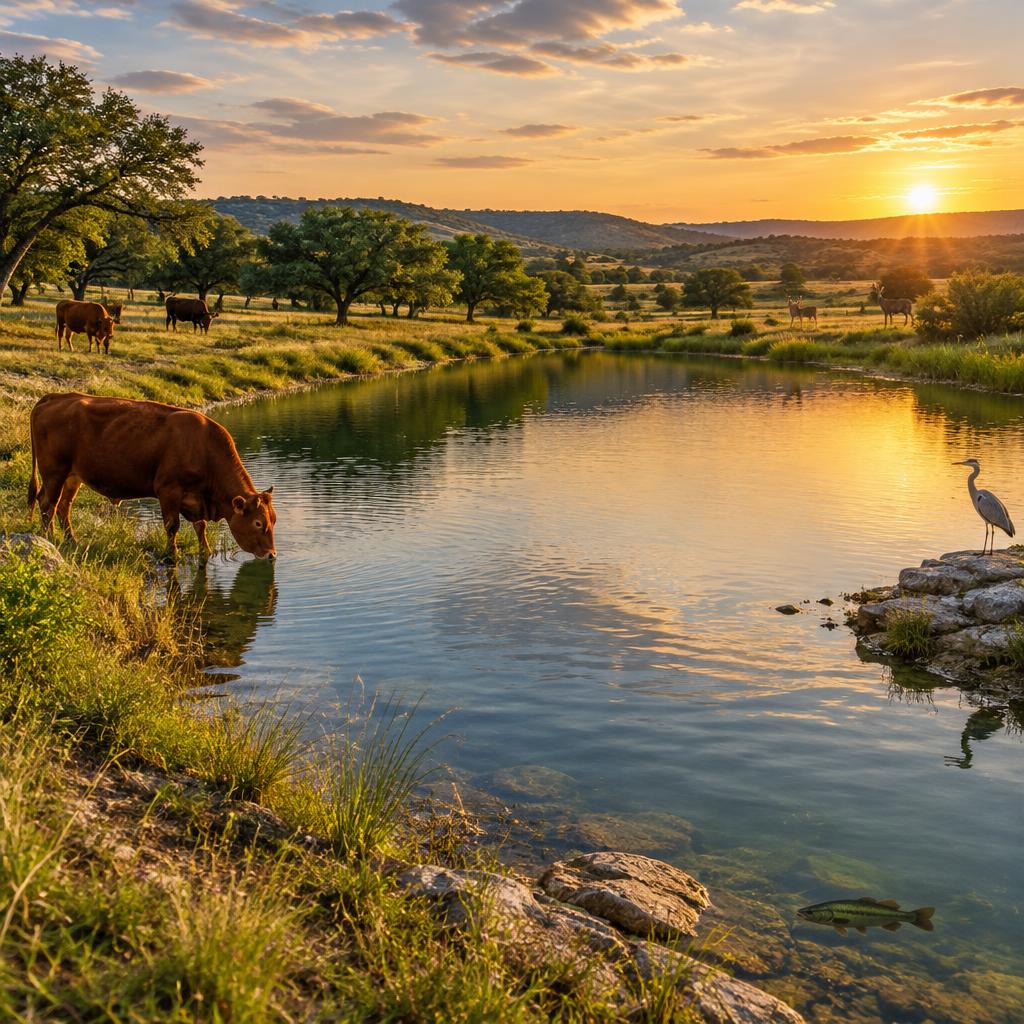
A single well-designed pond can provide water for livestock, habitat for fish and native wildlife, and recreational value without requiring separate water features. In the Texas Hill Country—where variable rainfall, rolling topography, and limestone surface rock are common—combining uses saves land, reduces construction impacts, and helps concentrate management efforts. Planning from the start to accommodate multiple needs prevents costly retrofits later.
Choosing the right site and evaluating watershed
Start with a site that captures a reliable watershed and has suitable soils and topography for a pond. Look for natural draws or low points that will collect runoff and consider proximity to water lines or wells if supplemental supply is needed. Avoid locations with obvious drainage problems that could cause excessive sedimentation. On rocky Hill Country sites, plan for rock excavation or milling as part of the earthwork; services that break down or recycle surface rock can reduce hauling and improve site preparation.
Designing depth zones for livestock, fish, and wildlife
A multi-use pond benefits from distinct depth zones rather than a uniform slope. Shallow, gently sloped margins provide foraging and amphibian habitat; intermediate shelves allow emergent plants to establish; and a deeper central area gives fish a thermal refuge and helps sustain oxygen levels. Designing these zones intentionally supports diverse uses while minimizing conflict—shallow edges discourage livestock from trampling breeding areas, while deeper pockets improve fish habitat.
Access points, bank reinforcement, and fencing
Plan livestock access and human access separately when possible. A hardened or rocked watering pad reduces bank erosion where cattle drink; fencing or a controlled crossing can keep livestock out of sensitive spawning or vegetated edges. Where natural banks are unstable or rock outcrops exist, consider rock crushing or grinding to produce aggregate for bank stabilization and road/driveway surfacing. Thoughtful placement of access tracks and crossings reduces long-term maintenance needs.
Vegetation, habitat features, and shoreline layout
Use a mix of native emergent and shoreline vegetation to stabilize banks, filter runoff, and provide cover for fish and wildlife. Preserve woody debris or create brush piles in deeper areas to offer structure for fish. Maintain vegetated buffer strips upslope of the pond to trap sediment and nutrients. When clearing around the site, techniques like forestry mulching can remove invasive cedar and brush while returning organic material to the soil without burning or hauling excessive debris.
Water supply, spillways, and erosion control
Design reliable inflow and overflow features: an adequate spillway prevents uncontrolled overtopping during heavy rains, and controlled inlets protect banks from concentrated flows. If relying partly on wells or pumps, plan for redundancy and consider where outages would impact cattle. Long-term erosion control includes well-graded inlet channels, riprap or rock-armored points of concentrated flow, and vegetation to slow runoff—work that can be coordinated with rock and earthwork services available locally.
Maintenance planning and long-term stewardship
Every pond needs routine attention: monitor sediment accumulation, check banks and access pads after storms, manage shoreline vegetation to prevent encroachment, and inspect spillways and dams. Periodic light thinning of overhanging brush and targeted removal of invasive species preserves open water and habitat balance. Where sediment buildup or rock chokes access, local services such as rock milling, rock crushing, and selective excavation can restore functionality without replacing the entire structure.
Next steps with Texas Ranch Construction and local examples
If you’re planning a multi-use pond on a ranch near Llano, Harper, Medina, or elsewhere in the Texas Hill Country, work with a contractor experienced in local soils, rock conditions, and multi-purpose pond design. Texas Ranch Construction offers pond and lake construction, rock milling and crushing, forestry mulching, and related land-clearing services that can simplify the project from site prep through shoreline shaping. For project guidance or a site visit, contact Texas Ranch Construction directly at (830) 431-8952 or visit https://www.texasranchconstruction.com to learn more and schedule a consultation.
Article by
Texas Ranch Construction
Texas Ranch Construction is your premier choice for expert land clearing services in Kerrville and the Texas Hill Country. Whether you need land clearing, cedar mulching, forestry mulching, brush removal, rock milling & rock crushing, or pond and lake construction, we’ve got you covered! With over 20 years of experience, we have established ourselves as a trusted leader in the industry. Our commitment to delivering top-quality results has made us the best choice for clients in Kerrville, Fredericksburg, Comfort, Sisterdale, Stonewall, Center Point, Harper, Llano, Boerne, Medina, Bandera, and Johnson City.